Cutting & Materials
1D nesting vs 2D nesting: when does each apply?
Bars and sheets are both cut from stock, but the problem isn't the same. Here's how to tell which one you're dealing with, and what changes.
Cutting from stock means fitting the parts you need into the material you buy. In a steel workshop, the question comes in two shapes. Bars and profiles are a one-dimensional problem. Sheets and plates are a two-dimensional one. They look alike on a quote, but they don't behave alike in the workshop.
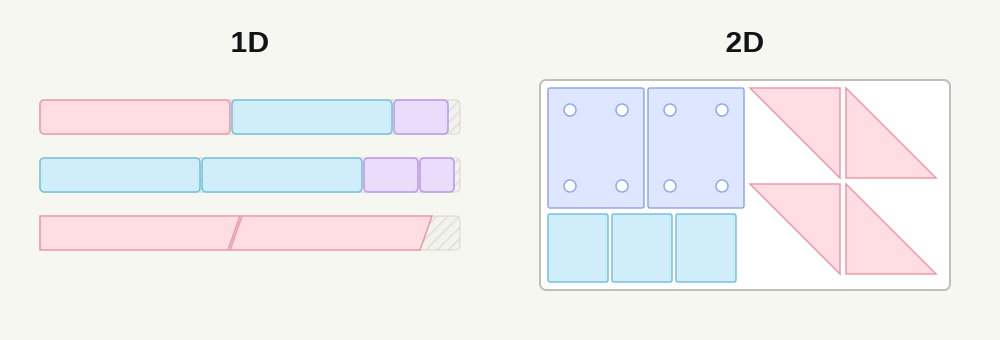
1D: lengths along a bar
Profiles, tubes, flats and angles are bought in fixed lengths, often 6 or 12 m. Only one dimension matters: length. The question is which pieces go on which bar, so that you buy as few bars as possible and what's left at the end is either tiny or worth keeping.
What makes it harder than it looks:
- The kerf. Every cut removes a few millimetres. On a bar cut into eight pieces, it adds up.
- Mitre and bevel cuts. A piece cut at an angle uses more than its nominal length, unless two pieces are laid head to tail and share the same cut.
- Pieces longer than the bar. A 15 m rafter in 12 m bars has to be spliced. Where the joint goes, and what kind of joint, is an engineering decision, not just an arithmetic one.
- Mixed stock. Several bar lengths, limited quantities, offcuts you'd like to use first.
2D: shapes on a sheet
Base plates, gussets, stiffeners and flanges are cut from sheets. Now there are two dimensions, plus rotation. The question is how to place the outlines so that you use few sheets and the leftover is one usable piece rather than lace.
What makes it harder:
- Irregular shapes. A trapezoid gusset placed straight leaves a triangle empty beside it. Two of them head to tail fill it.
- Process gaps and margins. Plasma, laser and oxy-fuel each need space between parts and at the sheet edge.
- Holes and cut length. The plan decides how much the machine will cut, and for how long.
- Several sheet sizes. The best plan on one format may be a poor one on another.
Side by side, on a real calculation
Two plans taken from the case studies, to see what changes from one world to the other.
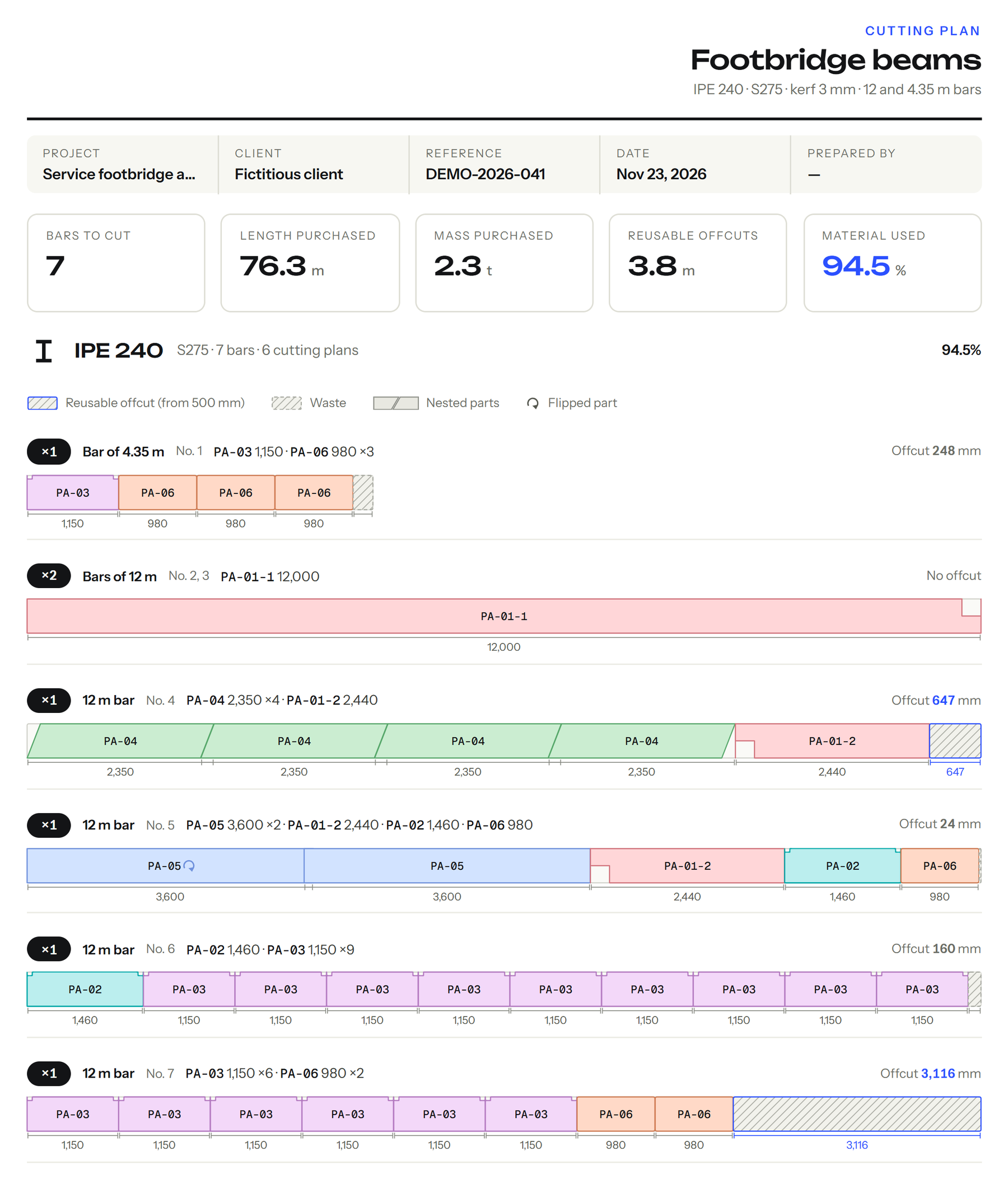
On a bar, what separates two parts is the saw kerf: 3 mm here, counted at every cut. A part cut on a bevel can share its cut with the next one, laid head to tail.
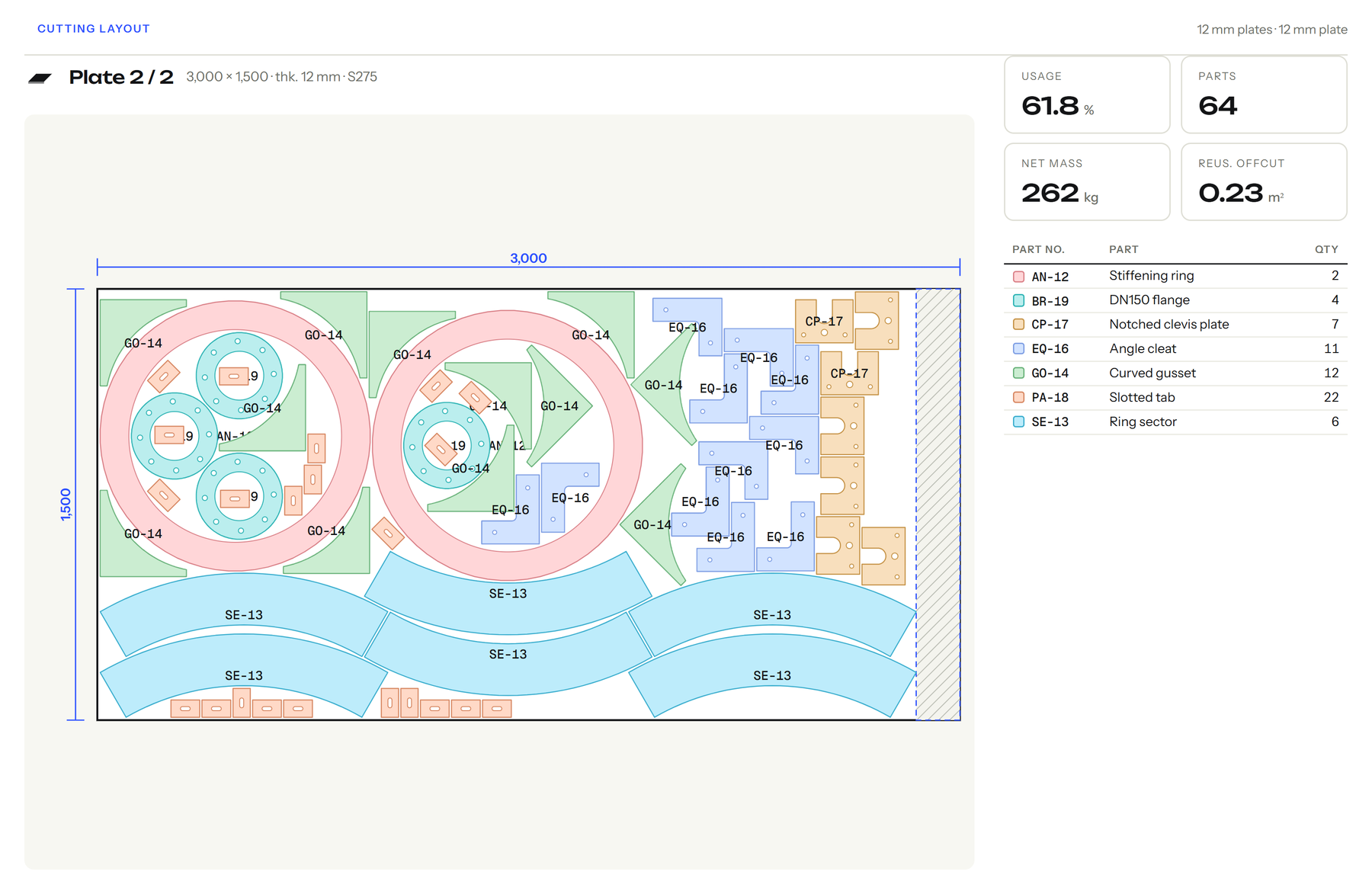
On a sheet, the spacing between parts and the edge margin play that role, and they depend on the process: plasma doesn't need the same clearance as laser. Both are set before the calculation, like the kerf for bars.
How to tell which one you need
| 1D | 2D | |
|---|---|---|
| Material | Bars, profiles, tubes, flats | Sheets and plates |
| What matters | Length | Outline and area |
| Typical parts | Columns, beams, purlins, bracing | Base plates, gussets, stiffeners |
| Main constraints | Kerf, angled cuts, splices | Gaps, margins, rotation, holes |
| Typical output | A cutting list, bar by bar | A sheet layout and a file for the machine |
A quick example with assumed figures: twelve purlins of 5,990 mm in a 12 m section is a 1D job. Two purlins fill a bar, and with a 3 mm kerf about 17 mm is left at the end. Twenty gussets and eight base plates in 10 mm steel is a 2D job, and how well they fit depends on their shapes as much as on their sizes.
When it's both
Most steel structures need both. The members come from bars, the connections from sheets. The quantities then meet in the same place: weight of bars, weight of sheets, paint area, cutting time. That's why it helps when both calculations sit in the same project, instead of in two tools that never talk to each other.