Engineering Workflows
A BOQ is not a quotation, and that's useful
A bill of quantities says what a job needs. A quotation says what you'll charge for it. Keeping them apart makes both easier to check.
In many workshops, the bill of quantities and the quotation live in the same spreadsheet. Quantities in one column, prices in the next, totals at the bottom, and a few adjustments made directly in the cells. It works, until someone needs to know where a number came from.
What a BOQ is
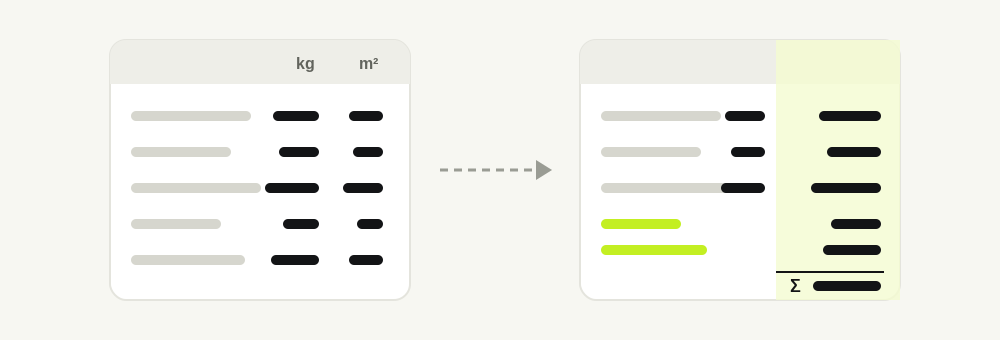
A bill of quantities lists what the job needs: material by section and by thickness, weights, surfaces to paint, cutting time, holes. Each line can be traced back to the parts that produced it.
It answers a technical question. It should be the same whoever prices the job.
What a quotation is
A quotation says what you'll charge: material at your prices, labour, transport, erection, overheads, risk, margin, payment terms and exclusions. It's a commercial document, and it reflects your company's choices.
Two companies with the same BOQ can, and often will, send different quotations.
Why keeping them apart helps
- You can check quantities on their own. Someone can compare the BOQ with the drawings without commercial assumptions getting in the way.
- Prices change without touching quantities. Steel goes up, you update one rate. The quantities stay as they were.
- Drawings change without touching your pricing logic. A revision changes the quantities. Your rates and your margin stay where they were.
- Two people can work on it. One checks what the job needs, the other decides what to charge.
Net weight, gross weight
A BOQ built from the parts gives the net weight: the steel that ends up in the structure. What you buy is the gross weight: whole bars and whole sheets. The difference is the offcut.
When the BOQ starts from cutting plans, the gross weight comes from the plans themselves, line by line, instead of from a percentage added at the end.
One line, from net weight to material cost
Take the footbridge's IPE 240, from the case study. The parts weigh 2,217 kg: that's the net weight, the steel that goes to site. Cutting them took 76.4 m of bars, one offcut from stock and six 12 m bars: 2,344 kg, the gross weight, the steel you pay for.
Material cost is calculated on the gross weight: at an example price of 1,000 FCFA per kilo, the line comes to 2,344,000 FCFA. Kalepis shows it as soon as you enter your price, per kilo or per bar. The 3.8 m of reusable offcuts go back to the rack: paid for on this job, they'll serve the next.
The quote starts from there and adds what the BOQ can't know: labour, painting the 66.6 m² to be coated, transport, erection and your margin.
How Kalepis handles it today
In Kalepis, the BOQ is built from the cutting results of the project. Unit prices are optional, and the estimate exports to Excel with its totals kept as formulas. Your company stays free to build its quotation the way it prefers.
What stays your call
Labour rates, transport, erection, overheads, risk and margin are business decisions. A tool can make the quantities clear and traceable. The price you put on the job is yours.