Cutting & Materials
What does cutting yield actually tell you?
A high utilization percentage looks good. But it's only one part of the material decision. Here's what to check before trusting the number.
A cutting plan can show 90% material utilization and still be the wrong plan for the workshop. Maybe it uses a sheet size you don't stock. Maybe it creates offcuts you can't use. Or maybe another layout is slightly less efficient on paper but faster to prepare. Yield is useful. It just isn't the whole decision.
What the number measures
For a sheet, yield is the area of the parts divided by the area of the sheets used, times 100. For bars, it's the length of the pieces divided by the length of stock used. Simple enough, as long as you know what sits on each side of the fraction.
Two questions change the result:
- Which sheets or bars count? If the last sheet is only half used, do you count it whole? Many plans do, because you bought it whole. Others count only the part that was cut and treat the rest as stock. Same layout, different number.
- What counts as part? The outer outline, or the outline minus its holes? A base plate with four holes holds less steel than its rectangle. Counting the rectangle makes the yield look better than the steel you'll actually turn into parts.
What it leaves out
Yield says nothing about:
- Kerf and trims. The saw blade or the cutting process removes material, and sheet edges are often trimmed.
- Machine constraints. Minimum gaps between parts, margins at the edge of the sheet, lead-ins. A plan that ignores them can't be cut as drawn.
- The stock you actually have. A great yield on a 6,000 × 2,000 sheet doesn't help if your supplier delivers 3,000 × 1,500.
- Reusable offcuts. A clean strip that goes back on the rack isn't the same as scattered scrap, yet both count as "not part".
- Time. Setting up, sorting parts, handling one more sheet.
A worked example
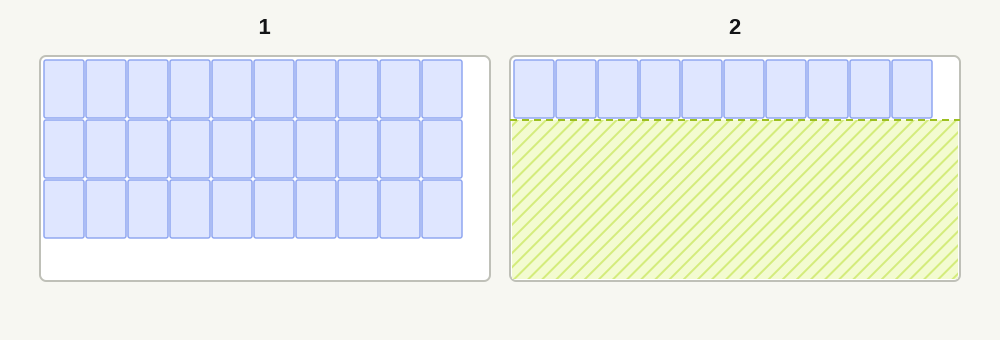
Say you need 40 rectangular plates of 280 × 400 mm in 10 mm steel, and you cut them from 3,000 × 1,500 sheets. Ignore kerf and margins to keep the arithmetic readable.
One sheet holds 10 plates along its length (10 × 280 = 2,800 mm) and 3 rows across its width (3 × 400 = 1,200 mm): 30 plates. The 40 plates need two sheets, 30 on the first and 10 on the second.
| What you count | Calculation | Yield |
|---|---|---|
| Both sheets, whole | 4.48 m² of parts / 9.0 m² of sheet | 49.8% |
| The first sheet only | 3.36 m² / 4.5 m² | 74.7% |
| What was actually consumed, if the 3,000 × 1,100 leftover goes back into stock | 4.48 m² / 5.7 m² | 78.6% |
Three numbers for one plan. None of them is wrong. They answer different questions: how much did I buy, how well is a full sheet used, how much did this job really consume.
How Kalepis calculates it
So that the figures in the application can be read without guessing, here is the convention it applies.
- Bars. The yield of a calculation is the useful length divided by the total length of the bars used, stock offcuts included. The useful length is the parts plus one saw kerf per cut; the last cut is not counted when the part ends exactly at the end of the bar. Everything else is offcut.
- Sheets. The yield of a sheet is the net area of its parts divided by the area of the sheet. The net area is the outline of the part minus its holes: a drilled plate counts for the steel it really contains. For a whole project, Kalepis divides the total net area by the gross area of the sheets.
- Reusable offcuts. They count as offcut like the rest, but Kalepis shows them separately: in blue on the bar cutting plan (from 500 mm with the default settings), and as an area "to keep" on each sheet. So you get both readings of the table above without redoing the maths.
In the footbridge case study, the IPE 240 shows 94.5%: 72.2 m useful out of 76.4 m of bars, with 3.8 m of reusable offcuts going back to the rack.
Comparing two plans fairly
Before you compare yields, check that both plans use:
- the same parts and the same quantities;
- the same stock sizes and the same quantities available;
- the same gaps, margins and kerf;
- the same definition of yield: whole sheets or consumed material, holes counted or not.
If one of these differs, the comparison tells you more about the settings than about the plan.
What to look at alongside yield
- The number of sheets or bars you'll have to buy.
- The size and shape of what's left, and whether it will really be reused.
- The cutting length and time, for sheets.
- Whether the plan can be cut exactly as drawn.
Yield is a good first signal. The decision comes from all of these together.