Cutting & Materials
Linear cutting optimization: a practical guide
Linear cutting optimization lays the lengths you need on the bars in stock. The settings that matter, from blade to offcuts, on a real footbridge.
Linear cutting optimization means laying the lengths a job needs on the bars you have, or the ones you're about to buy. The aim: buy as few bars as possible, and keep offcuts that will be used again. On a short list, you can do it in your head. On a whole steel structure, a few settings make all the difference.
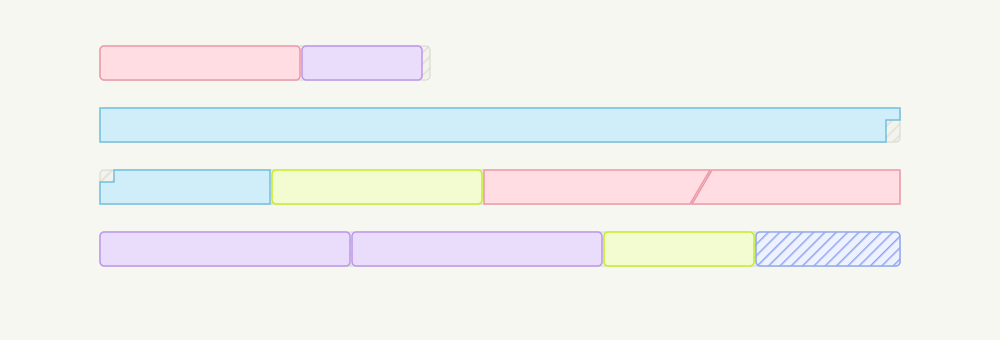
The example below is the footbridge from the case study, calculated in Kalepis: 165 parts in five sections, from IPE 240 to SHS 80 × 80.
Start from a complete list
A cut plan is only as good as its list. For each part you need:
- the mark and the quantity;
- the section;
- the length, stating which length for a bevelled part;
- the cut at each end: square, mitre or bevel, with its angle;
- any notches, with their position.
A part with a missing angle gets cut square, and too long. If the list already lives in a spreadsheet, it can be pasted or imported as it is, from Excel or CSV.
Declare the real stock
The calculation can only use the bars you give it. Enter the lengths your supplier delivers (6 m, 12 m…), limited or not, in your order of preference.
And start with the rack. On the footbridge, a 4,350 mm IPE 240 offcut and a 5,200 mm HEA 160 offcut were left over from an earlier job. They go first: that steel is already paid for.
Count the blade and the shortest piece
Every saw cut removes material. With a 3 mm blade, ten cuts on one bar eat 30 mm. Forget them, and the last part on the bar comes out short.
The other limit is the shortest piece the saw can hold and cut cleanly. Below it, the end of the bar goes to scrap, even if a part would fit on paper. Both are set once and for all in the settings.
Splice what is longer than the bar
The footbridge's main beams are longer than the 12 m bars. Kalepis splices them with a Z joint: 12,000 + 2,440 mm. The joint can also be square or bevelled, and placed automatically or by hand.
A splice on a load-bearing member is still an engineering decision: its position and type must be approved before cutting.
Lay bevels head to tail
The footbridge's knee braces are cut at 35°. Laid head to tail, two parts share a single saw cut: 167 mm saved each time. On a batch of bevelled parts, that is often one more part per bar.
Keep the right offcuts
The end of a bar isn't necessarily waste. Above a certain length, 500 mm on Kalepis cutting plans, it becomes a reusable offcut and goes back to the rack. On the footbridge, 23.3 m are kept, 9.4 m of them in SHS 80 × 80.
Read the result
| Section | Yield | Parts | Bars used | Reusable offcuts |
|---|---|---|---|---|
| IPE 240 | 94.5% | 32 | offcut 4,350 + 6 × 12 m | 3.8 m |
| HEA 160 | 89.6% | 18 | offcut 5,200 + 5 × 12 m | 5.9 m |
| UPN 140 | 93.0% | 11 | offcut 3,100 + 3 × 6 m | 1.0 m |
| Angle 70 × 7 | 94.9% | 56 | 2 offcuts of 2,400 + 14 × 6 m | 3.2 m |
| SHS 80 × 80 × 4 | 90.7% | 48 | offcut 3,200 + 9 × 12 m | 9.4 m |
Overall, 92.5% of the steel bought ends up as parts. Read the yield alongside the rest: one bar fewer matters more than a percentage point, and a good offcut kept beats a flattering yield. More on that in what cutting yield actually tells you.
Give the workshop what it needs to cut
A cut plan is only finished when it reaches the saw: a cutting plan bar by bar, in order, the part list with a dimensioned sheet for every notched part, and a label per part with its barcode. Kalepis produces all three as PDFs from the same calculation.